CEGR 492 · Proposal Development
Problem Statement Builder
Write a concise, technical, evidence-based problem statement.
Problem Statement: one paragraph that governs the project
0 of 3 lecture sections read
Engineering story
An advisor reads two problem statements. The first: 'There is a need to improve stormwater management in the area.' The second: 'The 14th Street storm sewer surcharges above rim elevation in the 10-year design storm at four structures, violating the municipal criterion of HGL ≤ rim − 1 ft, exposing 38 properties and one emergency route to repeated flooding; the deficiency is attributable to a 22 percent increase in impervious cover upstream since the 1988 design.' Only the second can be graded, budgeted, designed against and defended.
- What is the engineering problem?
- A vague statement cannot generate objectives, cannot bound scope, and cannot be shown to be solved.
- What information is missing?
- In the first statement: the location, the criterion, the magnitude, the affected population and the cause.
- What should the engineer evaluate?
- Whether the statement contains condition, criterion, magnitude, consequence and attribution.
- What decision must be made?
- Whether the statement is precise enough to govern every downstream section.
- How does this lesson help?
- This lecture supplies the five-element formula and a test you can apply to your own paragraph in two minutes.
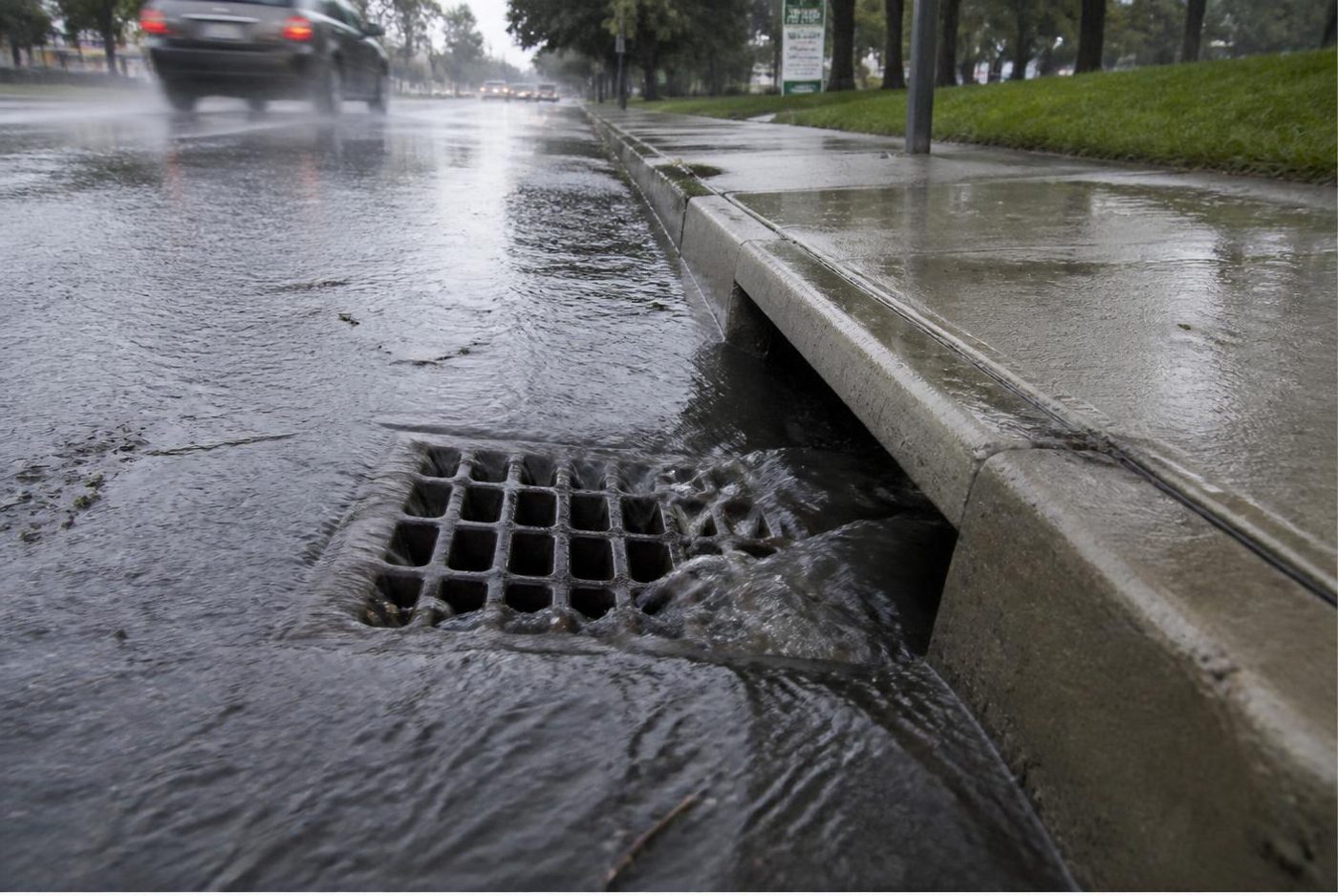
Photo 1. A problem statement earns its verbs here: water ponding at the inlet, the criterion it violates, and the consequence if nothing changes.
Capstone Studio instructional photograph
Why this matters
- The problem statement is the control document: objectives, methodology, results and conclusions all trace to it.
- Public safety: consequence must be explicit so that reviewers can weigh urgency.
- Professional practice: owners fund statements that quantify exposure, not statements that express concern.
- Assessment: ABET evidence for problem formulation is drawn directly from this paragraph.
Learning objectives
- Formulate a problem statement containing condition, criterion, magnitude, consequence and attribution.
- Verify traceability between the statement and each objective.
- Evaluate a draft statement against the five-element test.
- Distinguish a problem statement from a purpose statement and from a solution.
ABET evidence: SO 1 · SO 2 · SO 3 · CE-PC1
Prerequisite review
Problem identification
The evidence and root-cause work you completed supplies the attribution clause.
Open refresher1. The five elements
A complete problem statement contains five elements. Condition: what is measurably true now. Criterion: the standard or requirement the condition violates, with its source. Magnitude: how far the condition is from the criterion, in units. Consequence: who or what is exposed, and to what. Attribution: the mechanism responsible, to the extent it has been established.
Each element does work downstream. The condition and criterion define your acceptance test in CEGR 493. The magnitude sizes the intervention. The consequence justifies the project. The attribution determines which intervention class is even relevant. A statement missing an element leaves that decision unmade, and it will surface later as a revision request.
Statement = Condition + Criterion + Magnitude + Consequence + Attribution
- Each element cited to evidence developed in problem identification and background
Avoid this trap. Do not embed the solution. 'The bridge needs a new deck' presumes the answer; the statement's job is to establish the deficiency the design must resolve.
Photo 2. Location, condition, criterion, consequence and decision — all five readable in one inlet during one storm.
Capstone Studio instructional photograph
2. Problem, purpose and solution are three different sentences
The problem statement describes an unacceptable condition. The purpose statement describes what your study will do about it. The solution is the outcome of the work and does not belong in Chapter 1 at all. Collapsing these confuses reviewers and, more damagingly, pre-commits you to an approach before the analysis is done.
A practical test: if new evidence changed which alternative is best, would your problem statement still be true? If not, you have written a solution.
3. Traceability
Every objective must be derivable from the statement, and every element of the statement should be addressed by at least one objective. Build the trace matrix explicitly: statement element in the rows, objectives in the columns. Empty rows mean an unaddressed deficiency; empty columns mean scope creep.
This matrix is also your defense at the final review. When a committee member asks why an analysis was performed, the matrix answers in one cell.

Photo 4. Traceability is checked out loud at advisor review: does every objective answer the stated problem?
Capstone Studio instructional photograph
Table 1. Five-element test applied to a weak and a strong statement.
| Element | Weak statement | Strong statement |
|---|---|---|
| Condition | Flooding occurs | HGL exceeds rim at four structures in the 10-year storm |
| Criterion | None | Municipal manual: HGL ≤ rim − 1 ft |
| Magnitude | None | Exceedance of 1.4 to 2.8 ft |
| Consequence | Residents are affected | 38 properties and one emergency route exposed |
| Attribution | None | 22 percent impervious increase upstream since 1988 design |
Professional workflow
- Extract the measured condition from your problem identification evidence table.
- Cite the criterion to its clause, chart or manual section.
- Compute the magnitude of exceedance in units.
- State exposure quantitatively — properties, users, delay, cost or risk.
- Attach attribution supported by the root-cause analysis.
- Run the five-element test and build the traceability matrix to your objectives.
Applicable standards
Governing agency design manual
Source of the criterion that defines unacceptability.
ASCE Code of Ethics
Requires objective statements of fact and disclosure of limitations.
Case study — A committee revision driven by one missing element
A proposal quantified a hydraulic deficiency precisely but omitted attribution.
- The committee could not tell whether the fix belonged upstream (runoff control) or downstream (conveyance).
- Adding one attribution clause redirected the entire methodology and saved four weeks of misplaced analysis.
Lesson learned. Attribution is not optional detail; it selects the intervention class.
Source: Departmental proposal review records.
Why this section exists
The problem statement is the sentence your advisor, your review committee, and your future employer will read first. It must stand alone.
Learning objectives
- Assemble the eight required components
- Draft with the sentence builder
- Score the statement against ten quality dimensions
Problem Statement
Weak
The intersection is dangerous and should be redesigned with a roundabout.
Strong
The signalized intersection of Cold Spring Lane and Hillen Road operates at LOS F during the PM peak with 96 s of control delay per vehicle and recorded 34 crashes over three years, exceeding the agency's 20 s delay and critical-crash-rate thresholds; no current capital plan addresses the deficiency.
It measures the deficiency against a criterion and stops short of prescribing a solution.
Standards and codes
Frame the deficiency against a code-based or agency performance criterion so the shortfall is measurable.
Common mistakes
- Including the proposed solution.
- Multiple unrelated problems in one statement.
- Vague magnitude.
Research tips
- Structure: system → deficiency → evidence → consequence → stakeholders → need.
- One paragraph, no solution language.
- Every adjective should be replaceable by a number.
A roadway team wrote 'congestion is the problem' and designed a widening. Analysis later showed signal timing, not capacity, caused most delay.
- What went wrong?
- The deficiency was never measured, so the solution preceded the diagnosis.
- What information was missing?
- Delay by movement, signal timing plans, and saturation flow measurements.
- What should the team do next?
- Rewrite the statement around a measured deficiency before selecting any countermeasure.
- Which section addresses it?
- Problem Components and Quality Check
Walkthrough video
Mini quiz
Interactive checklist
0/5FE Civil connection — Statics and Mechanics of Materials
Structural problem statements must name the limit state, not just the visible distress.
Reference Handbook: FE Reference Handbook — Mechanics of Materials (section placeholder)
- Determine the governing limit state for a bolted tension member. (placeholder)
- Compute maximum bending stress in a simply supported beam. (placeholder)
- Identify the deflection limit for a serviceability check. (placeholder)
Recommended resources
- Weak vs. strong examples — Eight civil engineering comparisons in this module.