This deliverable is not counted toward your grade
Project Start and Technical Implementation (site, data and investigation) pages are required practice but are not counted toward your final grade. Your engineering grade comes from Chapter 4 and Chapter 5.
Site Investigation Program
Plan and document the field investigation: boring layout, sampling depths, in-situ testing and logs.
Section progress
0% of the workflow complete
Field & Laboratory · Plan, execute and document field and laboratory data collection to a defensible quality standard.
Deliverable: Site investigation report
How to complete this section
Do this next: Read the Site Investigation Program lecture and the worked example so you know what "Site investigation report" has to contain.
Not sure how to start or how much depth is expected? Read the fully written model example for this deliverable first — it shows the structure, tables and level of justification your advisor grades against.
Site Investigation Lab — what this workspace teaches
Plan, execute and document field and laboratory data collection to a defensible quality standard.
- Planning a subsurface, structural or traffic field investigation
- Instrumentation selection, resolution, accuracy and calibration records
- GPS/GNSS positioning: datums, projections, RTK vs. handheld accuracy
- GIS data capture, attribute schemas and coordinate metadata
- Land surveying: traverses, levelling, closure and error adjustment
- Sampling strategy: representative sampling, spacing, depth intervals, replicates
- ASTM/AASHTO laboratory testing procedures and reporting requirements
- Chain of custody, sample labelling and preservation
- QA/QC: duplicates, blanks, repeatability and data validation rules
End-of-term milestones
- Tuesday, November 17, 2026 — Poster printed and ready. 36 in × 48 in poster finalized and printed one week before the November 24 showcase.
- Wednesday, November 18, 2026 — Final document package uploaded for scoring. Chapters 4–5, calculation package, drawings and appendices uploaded in the app for advisor scoring.
- Wednesday, November 18, 2026 — Poster presentation to faculty and industry. Wednesday poster session — printed 36 in × 48 in poster presented in person; industry reviewers score communication and impact.
- Wednesday, November 25, 2026 — Oral presentation and defense (scored). Scored oral presentation and defense held on Wednesday, November 25.
Site Investigation Program
Plan and document the field investigation: boring layout, sampling depths, in-situ testing and logs.
Section B
Engineering story
A real project situation that frames this module
A geotechnical engineering team hits site investigation program in week 3, with the subsurface interpretation and foundation recommendation already promised to the owner. Plan and document the field investigation: boring layout, sampling depths, in-situ testing and logs. The reviewer starts at the end and works backwards, and the chain breaks at apply the approved Capstone I methodology to site investigation program.
All inputs traceable to data, code or the approved proposal. Because document assumptions, governing standards and units for every decision, the error does not stay local: it is carried into the data foundation every later calculation silently depends on, and every downstream product inherits it before anyone notices.
Adjacent property owners, excavation crews and the geotechnical engineer of record carry the consequence. On this module specifically, the exposure runs through produce evidence an advisor can verify independently, and the cost of correction rises every week the subsurface interpretation and foundation recommendation moves closer to issue.
Decisions the engineer must make
- What record establishes apply the approved Capstone I methodology to site investigation program, and is that record in the project data inventory?
- Which adopted document governs this decision, and who confirmed it applies in this jurisdiction?
- What is the acceptance criterion for document assumptions, governing standards and units for every decision, and was it written before the result was known?
- Is the documented procedure valid for the conditions this project actually presents?
- If the check fails, does the team revise the subsurface interpretation and foundation recommendation or raise a change request against the locked baseline?
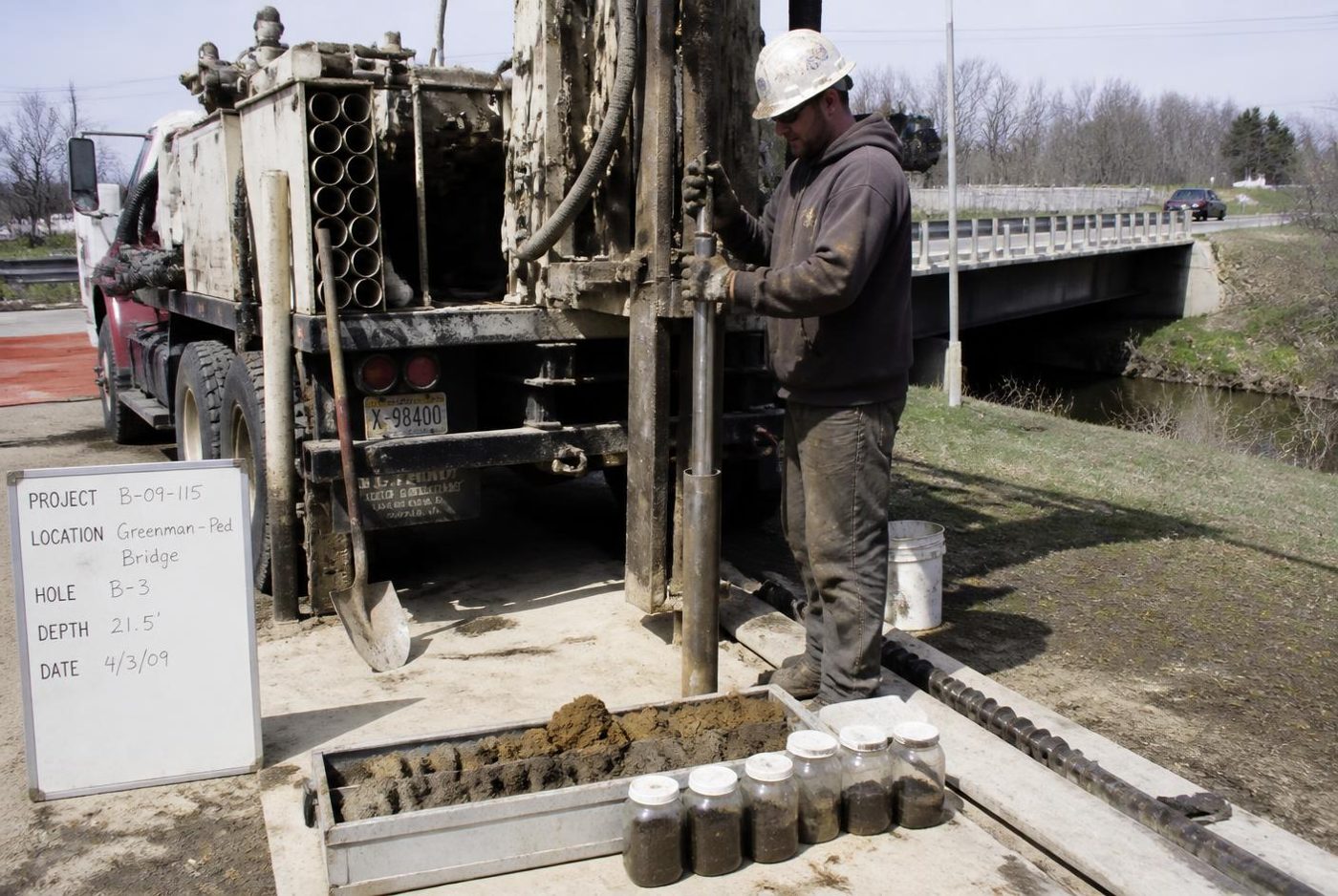
Photo 1. Subsurface investigation: SPT samples and the boring log that every geotechnical number traces back to.
Capstone Studio instructional photograph
Section C
Why this matters
Professional
Site Investigation Program is judged on whether an independent engineer can follow your reasoning to the same conclusion. Your site investigation report is the evidence that they can.
Technical
Apply the approved Capstone I methodology to site investigation program controls the numbers this module hands forward. Document assumptions, governing standards and units for every decision determines whether those numbers remain valid once conditions change.
Safety
The failure mode this module guards against is settlement, bearing failure or slope instability below the finished grade. It reaches people through produce evidence an advisor can verify independently, which is why the safety check is recorded explicitly here rather than inferred from a passing strength or performance check.
Economic
The data foundation every later calculation silently depends on is priced from this work. Quantities, unit costs and schedule float all trace to apply the approved Capstone I methodology to site investigation program; a late correction here is paid for as a change order, not a redline.
Environmental
Environmentally, this module fixes spoil handling, dewatering discharge and groundwater drawdown near the site. Choosing conservatively without justification is not free — the excess shows up as material, energy and land that the project consumes for no measurable gain.
Community
Neighbors whose structures, utilities and streets sit within the zone of influence inherit whatever this module decides — performance, accessibility, cost of ownership and resilience are set here, not at the ribbon-cutting.
Section D
Learning objectives
By the end of this module you will be able to:
- 1.Analyze apply the approved Capstone I methodology to site investigation program, using this project's own conditions rather than a textbook case.
- 2.Explain document assumptions, governing standards and units for every decision, using this project's own conditions rather than a textbook case.
- 3.Explain produce evidence an advisor can verify independently, using this project's own conditions rather than a textbook case.
- 4.Produce site investigation report at a standard the geotechnical reviewer for the owner would accept without a second revision cycle.
Section E
Instructional content
Full lecture notes with figures and governing equations
Site Investigation Program: from proposal statement to engineering product
Plan and document the field investigation: boring layout, sampling depths, in-situ testing and logs. That single sentence hides the substance of the module: apply the approved Capstone I methodology to site investigation program, and document assumptions, governing standards and units for every decision. Both must be established from project evidence before anything downstream is credible.
In geotechnical engineering, this work is the input to the subsurface interpretation and foundation recommendation. Produce evidence an advisor can verify independently — which is why this page asks you to record the source of every quantity, not just its value. The data foundation every later calculation silently depends on depends on it.
- Apply the approved Capstone I methodology to site investigation program.
- Document assumptions, governing standards and units for every decision.
- Produce evidence an advisor can verify independently.
Photo 1. Site Investigation Program: from proposal statement to engineering product in practice — Subsurface investigation: SPT samples and the boring log that every geotechnical number traces back to.
Capstone Studio instructional photograph
Decision logic: the procedure that replaces a closed-form solution
Site Investigation Program is governed by a documented procedure rather than a single expression, so the decision logic is the deliverable: what you accept, what you reject, and on what evidence. Apply the approved Capstone I methodology to site investigation program.
Write the acceptance criterion before you look at the result. Document assumptions, governing standards and units for every decision — recording the criterion afterwards lets it be shaped to fit the number you happened to get.
Photo 2. Decision logic: the procedure that replaces a closed-form solution in practice — Subsurface investigation: SPT samples and the boring log that every geotechnical number traces back to.
Capstone Studio instructional photograph
Constraints, adopted standards and the safety case for site investigation program
No single code section governs this module, so the constraint set comes from the approved proposal, the owner's requirements and professional practice. Write those constraints down; an unwritten constraint is not enforceable at review.
The safety case is explicit here. The failure mode is settlement, bearing failure or slope instability below the finished grade; the people exposed are adjacent property owners, excavation crews and the geotechnical engineer of record; the control that prevents it is produce evidence an advisor can verify independently together with an independent check by someone who did not perform the work.
- Controlling criterion for this module: apply the approved Capstone I methodology to site investigation program.
- Adopted reference: confirm with the jurisdiction before you rely on it.
- Failure mode guarded: settlement, bearing failure or slope instability below the finished grade.
- Evidence produced: Site investigation report.
Photo 3. Constraints, adopted standards and the safety case for site investigation program in practice — Subsurface investigation: SPT samples and the boring log that every geotechnical number traces back to.
Capstone Studio instructional photograph
Where this method stops being valid
Every method has a domain of validity. State the range of geometry, loading, material behaviour or flow regime over which your approach holds, and state what you would do instead beyond it.
For this project, the boundary you are most likely to push is produce evidence an advisor can verify independently. If you cross it, say so in writing, bound the error, and carry the limitation into your results chapter. A disclosed limitation is professional practice; a silent extrapolation is not.
Photo 4. Where this method stops being valid in practice — Subsurface investigation: SPT samples and the boring log that every geotechnical number traces back to.
Capstone Studio instructional photograph
Section F
Engineering workflow
Steps
- 1. Assemble the inputs this module needs — apply the approved Capstone I methodology to site investigation program; document assumptions, governing standards and units for every decision — each with a unit and a source record.
- 2. Confirm which document governs, and record who verified that it applies here.
- 3. State the assumptions and the acceptance criterion for apply the approved Capstone I methodology to site investigation program.
- 4. Execute the documented procedure, recording each judgement and the evidence behind it.
- 5. Test the result against produce evidence an advisor can verify independently.
- 6. Audit units and run an order-of-magnitude check by hand before the number leaves your desk.
- 7. Obtain an independent check from a teammate who did not perform the work, and record their name and date.
- 8. Assemble site investigation report and submit it to the geotechnical reviewer for the owner for review.
Decision points
- Is every input behind apply the approved Capstone I methodology to site investigation program traceable? If not — stop and collect the record.
- Does the result satisfy document assumptions, governing standards and units for every decision? If not — revise the work, never the criterion.
- Would the correction change the data foundation every later calculation silently depends on? If yes — raise a change-control request before proceeding.
- Have you ruled out the most common error on this module — all inputs traceable to data, code or the approved proposal?
Quality checklist
- Documented: apply the approved Capstone I methodology to site investigation program
- Documented: document assumptions, governing standards and units for every decision
- Documented: produce evidence an advisor can verify independently
- Governing document cited
- Procedure steps recorded in order with evidence
- Acceptance criterion recorded before the result
- Independent check signed and dated
- Site investigation report attached and named per the course convention
Section H
Interactive visualization
Site Investigation Program — step-through
Advance one frame at a time. Each frame adds one engineering decision to the previous state.
Step 1 of 6
Start from the confirmed inputs: geometry, materials, loads or flows, each with a source.
Section I
Applicable codes and standards
Section J
Worked examples
Full engineering solution format
Section K
Common mistakes and how to avoid them
- All inputs traceable to data, code or the approved proposal
- Units consistent and dimensionally verified
- Governing code or standard cited with clause number
- Independent check performed and initialed
- Deliverable file attached and named to convention
- Treating apply the approved Capstone I methodology to site investigation program as a given instead of establishing it from a project record.
- Producing site investigation report without showing how document assumptions, governing standards and units for every decision was satisfied.
- Recording the outcome of this module without recording the judgement and evidence that produced it.
- Missing produce evidence an advisor can verify independently, which is exactly the path to settlement, bearing failure or slope instability below the finished grade.
- Collecting data before defining what decision the data has to support.
- Accepting a laboratory or field value without its method, date, operator and uncertainty.
- Citing the wrong edition of a standard, or citing a standard that does not govern the jurisdiction.
- Leaving boundary conditions undefined so the model is not reproducible by an independent checker.
- Using inputs that no field record, laboratory report, or published source supports.
Section L
Industry case study
Documented failure related to site investigation program
A constructed civil works project where this module's decision was made incorrectly or skipped.
Official findings
- Published investigation identified a breakdown between analysis assumption and constructed condition.
Field observations
- The controlling assumption was documented nowhere in the design record.
- No independent check existed at the stage where the error entered the work.
Engineering interpretation
- Interpretation below is student analysis for instructional purposes, not an official finding.
- Map the failure to a step in your own workflow and state where your process would have caught it.
Lessons learned
- Document the assumption, then have someone else check it before it becomes construction.
Source: Summarize the published investigation; cite it in your reference list. Do not reproduce copyrighted report text.
Section M
FE Civil exam connection
Handbook FE Reference Handbook — geotechnical engineering section (record the section number from your handbook edition).
Exam topics
Handbook formulas
Weak results here feed your FE Civil Academy weak-area queue for targeted practice.
Question 1 of 2
Score: 0/2In site investigation program, which item must be established BEFORE the analysis is run?
Section N
Apply it to your project — Site Investigation Program
Complete this using your own capstone project data. Every field is saved to your project record and routed to your advisor with this module's submission.
Inputs and sources
Every value needs a traceable source.
| Quantity | Value | Unit | Source / record |
|---|
Assumptions and consequences
| Assumption | Basis | Consequence if wrong |
|---|
Self-check before submission
Section O
Design challenge
Consulting challenge — Site Investigation Program
Your firm has been retained to deliver the site investigation program scope for a municipal client on a compressed schedule. Produce the technical position your firm would defend at a public meeting.
Client request: The client wants a defensible recommendation, the basis of design, and an honest statement of what remains unresolved.
Constraints
- Adopted local code edition governs; no exceptions without written variance.
- Budget and schedule are fixed; scope changes require change control.
- Public safety and accessibility requirements are non-negotiable.
Deliverables
- One-page basis of design
- Supporting calculation extract
- Risk and limitation statement
Evaluation
- Technical correctness
- Standard compliance
- Clarity of engineering judgment
- Honest treatment of uncertainty
Section P
Documentation workspace
Write the report section for this module in the academic editor
Section Q
File uploads
Accepted: PDF, DOCX, XLSX, CSV, PNG, JPG, ZIP
No files uploaded yet.
Section R
Deliverable and advisor review
Site investigation report
Submissions route to your assigned faculty advisor and are scored independently by faculty and administrator rubrics.
Reflection
What was the hardest engineering judgment in this module, and how did you resolve it?
Section S
ABET outcome mapping
Site investigation report with advisor review and dual scoring.
Assessment: Faculty rubric score and administrator rubric score on this module's submission.
Rubric: Data quality · Target: 70% of students at or above 'meets expectations'.
Site investigation report with advisor review and dual scoring.
Assessment: Faculty rubric score and administrator rubric score on this module's submission.
Rubric: Data quality · Target: 70% of students at or above 'meets expectations'.
Section T
References and further study
Site Investigation Program — instructor design procedure
Course template for the calculation package format expected in the final report appendix.
NCEES FE Reference Handbook
Locate the equations used here and note the handbook section for exam recall.
Advisor meeting agenda item
Bring the unresolved decision from this module to your next weekly advisor meeting.