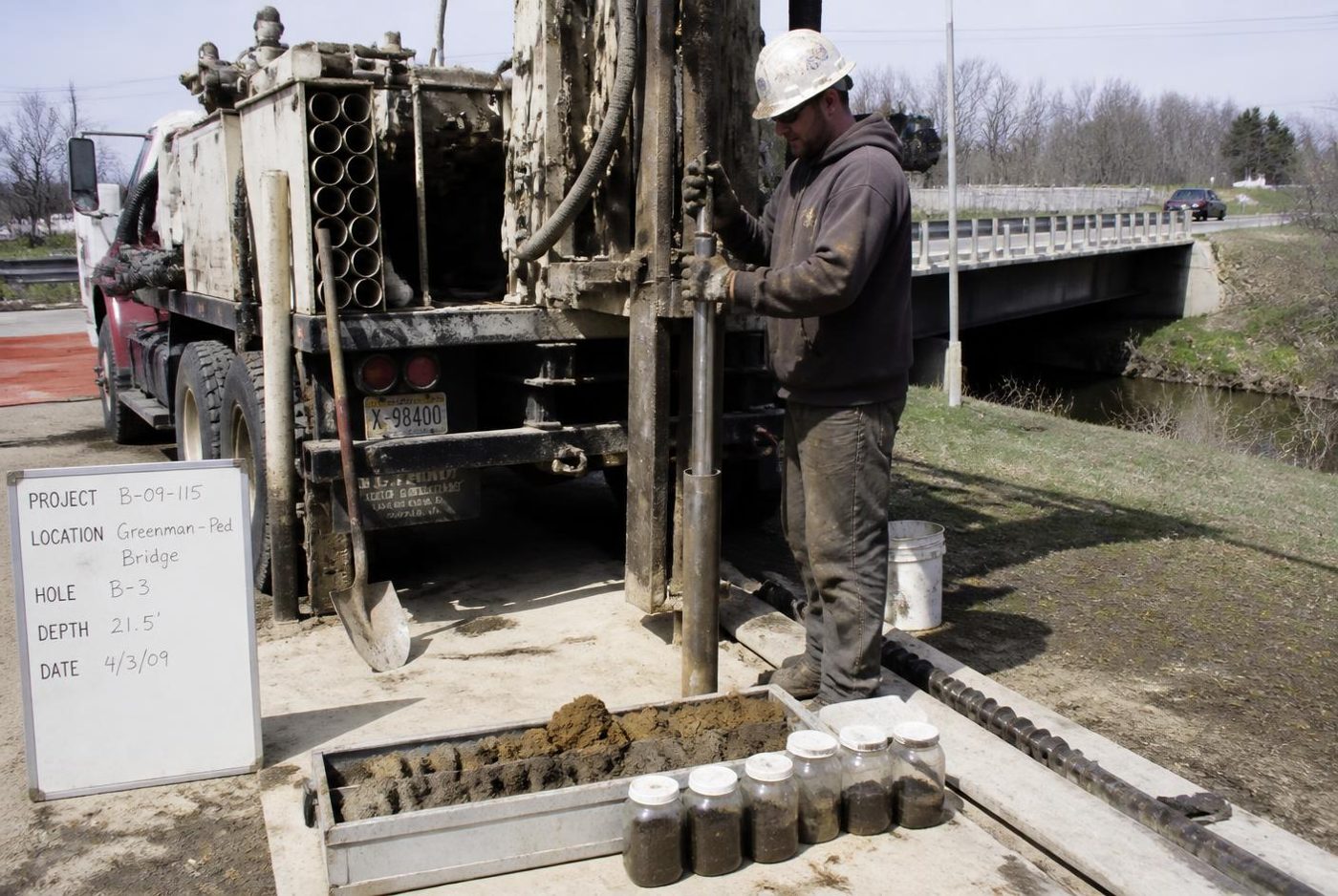
Phase IV · Research Methodology · Week 7
Geotechnical Engineering Methodology
Move from subsurface data to a defensible foundation, wall or slope design.
Preliminary work only. Calculations, models and estimates produced here are student coursework for proposal development. They are not sealed engineering documents and do not replace professional engineering judgment.
Geotechnical Engineering Methodology
Move from subsurface data to a defensible foundation, wall or slope design.
Learn
Learning objectives
- Build a soil profile from available data
- Select design parameters with justification
- Plan bearing, settlement and stability checks
Engineering guidance
Every geotechnical parameter must be traced to a test, a correlation or a conservative assumption you state out loud.
FE Civil connection
Geotechnical Engineering
Handbook §8 — Soil mechanics and foundations (placeholder)
- What factor of safety applies to sliding of a cantilever wall?
- How is consolidation settlement estimated?
- Which strength parameter applies to a short-term loading?
Technical methodology planner
Plan Chapter 3 against the exact equations, standards, data sources and design checks you will execute in Capstone II.
Write
Geotechnical methodology workflow
0/24 completeSoil profile builder
| Layer | Thickness (ft) | γ (pcf) | c (psf) | φ (deg) | N (SPT) | |
|---|---|---|---|---|---|---|
Effective stress at depth
σ (total) = Σγᵢhᵢ to depth 10 ft = 1170 psf
u (pore pressure) = γw(z − zgw) = 250 psf
σ' (effective) = σ − u = 1170 − 250 = 920 psf
Terzaghi shallow bearing capacity
Nc = 35.49, Nq = 23.18, Nγ = 30.21
qu = cNc + γDfNq + 0.5γBNγ = 22002 psf
qallow = qu/FS = 22002/3 = 7334 psf
Settlement: elastic + primary consolidation
Se = q·B·(1−μ²)·If/Es = 0.28 in
Sc = [Cc·H/(1+e0)]·log10[(σ'p+Δσ)/σ'p] = 1.67 in
Total settlement = 1.94 in
Slope stability screening (infinite slope)
FS = c/(γz·sinβ·cosβ) + tanφ/tanβ = 2.43
Screens acceptable (FS ≥ 1.5)
Retaining wall: Rankine lateral earth pressure
Ka = tan²(45−φ/2) = 0.333, Kp = tan²(45+φ/2) = 3.000
Pa = 0.5·Ka·γ·H² = 2.76 kip/ft
FSsliding = μW/Pa = 2.28 (≥ 1.5 OK)
FSoverturn = Mresist/Moverturn = 56.0/11.0 = 5.07 (≥ 2.0 OK)
Preliminary design summary
| Design item | Value | Basis / FE Civil link |
|---|---|---|
| Effective vertical stress | 920 psf | FE Civil: Soil Mechanics — effective stress |
| Allowable bearing pressure | 7334 psf | FE Civil: Foundations — bearing capacity |
| Total settlement | 1.94 in | FE Civil: Foundations — settlement |
| Slope stability FS | 2.43 | FE Civil: Slope stability |
| Wall sliding / overturning FS | 2.28 / 5.07 | FE Civil: Lateral earth pressure — retaining walls |
Write this section
Autosaves as you type. Use the ribbon for tables, figures, equations and symbols; cite in APA, e.g. (ACI Committee 318, 2019).
0 words · insert tables, figures, images, equations and symbols from the ribbon. Use APA in-line citations, e.g. (ACI Committee 318, 2019), and caption every figure and table.
0 words saved for this section.
Attach files for submission
Drop files here or click to browse
Calculations, drawings, spreadsheets, models, photos and reports up to 50 MB each.
Reflection
Do your bearing capacity, settlement and slope stability factors of safety meet typical code-minimum thresholds, and are soil parameters consistent with your profile?
Learning objectives
- Build a soil profile from available data
- Select design parameters with justification
- Plan bearing, settlement and stability checks
Engineering guidance
Every geotechnical parameter must be traced to a test, a correlation or a conservative assumption you state out loud.
FE Civil connection
Geotechnical Engineering
Handbook §8 — Soil mechanics and foundations (placeholder)
- What factor of safety applies to sliding of a cantilever wall?
- How is consolidation settlement estimated?
- Which strength parameter applies to a short-term loading?
Technical methodology planner
Plan Chapter 3 against the exact equations, standards, data sources and design checks you will execute in Capstone II.